2012年10月3日水曜日

China modernized North Korea’s TV news


The sudden refresh of North Korea’s staid state TV evening news appears be thanks to help from China’s state TV broadcaster.

China Central Television, the government-run broadcaster of China, donated 5 million yuan (about US$800,000) of equipment to North Korea’s Korea Central Television to help improve its news broadcasts, according to a Chinese news report.

There are very few details of the deal except for a single Chinese-language report and a piece from the Korea Central News Agency.

Here’s the North Korean report:

Pyongyang, September 26 (KCNA) — The Chinese Central TV donated equipment to the Central Broadcasting Committee of Korea.
A donating ceremony took place here on Tuesday.
Present there were Ri Chol, fire vice-chairman of the Central Broadcasting Committee of Korea, officials concerned, a delegation of the Chinese State Administration of Radio, Film and Television led by Vice-Minister Li Wei, Chinese Ambassador to the DPRK Liu Hongcai and embassy officials.
Speeches were made at the ceremony.
The participants looked round the donated equipment.

And here’s the Chinese report:

近日,中央电视台向朝鲜中央广播电视委员会捐赠设备仪式在朝鲜中央电视台举行。此次对朝捐赠设备为网络制作播出系统,价值500万元人民币,全部为中国民族品牌并具有自主知识产权,为朝鲜电视台提高新闻节目制作质量,告别磁带播出转入数字化时代发挥了重要作用。
9月25日,朝鲜中央电视台的导播人员正在工作。朝鲜中央电视台建立于1963年3月3日,位于平壤市牡丹峰区,是朝鲜民主主义人民共和国政府主办的官方电视台。 新华社记者张利摄 —Xinhua News Agency, Sept. 26, 2012.

Which loosely translated says the donation has taken North Korean TV into the digital age and helped it improve programming.

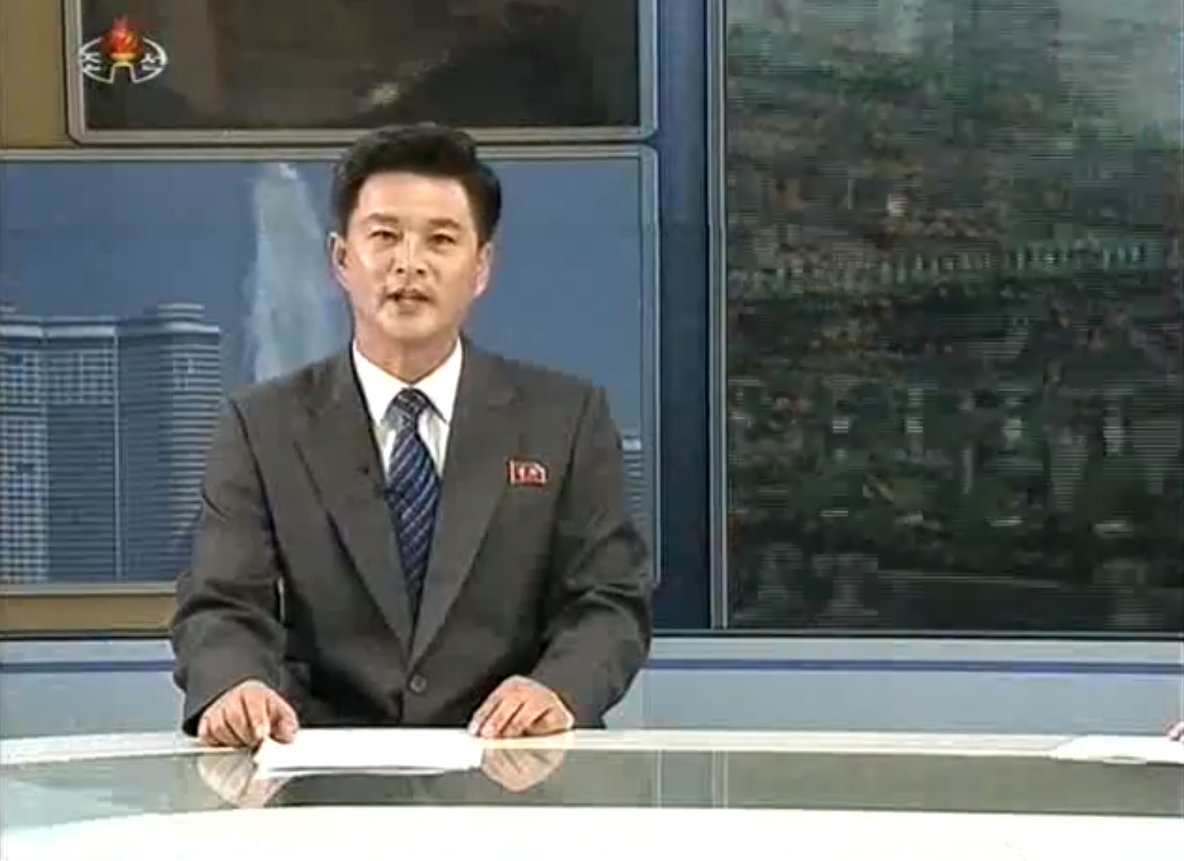
The ceremony in Pyongyang came less than two weeks after KCTV’s evening news underwent a make-over that included a new news desk, new backdrop, better graphics and a more modern look.

A further innovation — two news anchors sitting at the desk with a computerized background — just appeared making the news broadcasts look even more like those from the rest of the world. Before the changes, the news bulletins were very much of the presentation style seen in the 1970s in many countries.

Here’s a couple of screen grabs of the latest presentation (click to make them larger):

While the Chinese report was brief, Xinhua did run four photos that provide a rare glimpse behind the scenes at North Korean TV and show what is presumably the new equipment.


Visible in the picture of the control room are three Sony MPEG IMX video players, each worth about US$40,000. There’s a lot of other expensive broadcasting gear, some of it also bearing the Sony badge (Sony is the biggest manufacturer of broadcasting gear and is popular worldwide).

It’s a massive change from the news operation of old, which was disclosed when China Central Television went behind the scenes earlier this year.

The new equipment probably makes at least some of the station high-definition capable, although there’s probably be a lot more work to be done before we see the first HD images from North Korea’s state TV.

Related posts:

  1. China’s CCTV interviews Ri Chun Hui
  2. KCTV adds computer-generated backdrop to evening news
  3. Pyongyang News website offers archived TV news
  4. More on KCTV’s new-look news
  5. KCTV moving on Thaicom-5

China Central Television, Korea Central Television, Sony

「対北朝鮮投資専門基金」、北京で発足 中朝民間史上で初

http://headlines.yahoo.co.jp/hl?a=20120927-00000043-xinhua-cn

転電です。

「対北朝鮮投資専門基金」、北京で発足 中朝民間史上で初
毎日中国経済 9月27日(木)17時39分配信
【新華08網北京9月26日=黄ケン(火に亘)予】 中朝投資協力サミットおよび対北朝鮮投資専門基金の発足記念式典が、このほど北京市で開催された。

中国海外投資聯合会が主催し、中海投(北京)国際投資管理有限公司、中投信融(北京)国際投資管理有限公司が運営。中朝関係の現状と対北朝鮮投資の新政策について、各界の来賓が意見交流を行った。海外投資において上位100社にある中国企業よる北朝鮮訪問代表団も発足した。

今回の活動は、記者会見と現場フォーラムの形で実施され、中朝関係の発展動向、北朝鮮の投資環境、北朝鮮事業の調査などの議題について突っ込んだ議論が行われた。会場で、北朝鮮投資事務所の理事長、中投信融(北京)国際投資管理有限公司の孫浩烈董事長、中海投(北京)国際投資管理有限公司の鄭帥最高経営責任者(CEO)が、「中朝民間資本戦略協力協定」を結んだ。

また、中朝の民間資本同士の提携を促す目的で、中朝民間史上で初となる「対北朝鮮投資専門基金」が発足した。民間の力を借りて、中朝間の大規模な連携の迅速な展開を促す狙いだ。基金の規模は30億元で、初回は10億元が募集される。

「今は対北朝鮮投資の絶好の好機だ」と、中海投の郭夏チーフエコノミスト。「北朝鮮の相対的に少ない人口、国土面積および豊富な資源・鉱産物を考慮すれば、経済発展に力を入れれば、早期の達成が可能であり、これが達成できれば、北朝鮮の各分野の開発が進み、労働集約型産業が資金、知力集約型産業へと脱皮できる」と語った。

(翻訳 金慧/編集翻訳 伊藤亜美)

2012年9月30日日曜日

북한 인력, 중국 투먼·훈춘에 속속 고용


  • [앵커멘트]
    지난 5월 중국으로 첫 공식 수출된 북한 인력이 이후 3차례 더 들어와 현재 투먼과 훈춘 2개 도시에서 모두 3백여 명이 일하는 것으로 확인됐습니다.
    북한 인력은 미국과 일본, 중국계 기업이 고용하고 있고, 특히 중국이 정부 차원에서 고급 IT 인력을 별도 관리하는 점이 주목됩니다.
    김승재 특파원이 취재했습니다.
    [리포트]
    북한과 중국의 접경 도시, 투먼 시 개발구 안에 있는 일본계 건축 자재 회사입니다.
    공장에서 일을 마친 북한 여성 20명이 단체로 줄을 맞춰 기숙사로 퇴근하고 있습니다.
    투먼 시 경제 개발구 청사 5층에서는 고성능 컴퓨터 수십 대가 갖춰진 가운데 북한의 고급 IT 인력 29명이 일하고 있습니다.
    북한의 젊은 남녀 IT 인력이 알록 달록 화려한 옷을 입은 채 주변에서 쇼핑을 마치고 돌아오는 모습이 YTN 카메라에 잡혔습니다.
    이들 IT 인력은 다른 근로자와 달리 기숙사가 아니라 경제개발구 청사 안에서 숙식을 하고 있습니다.
    또다른 북-중 접경 도시 훈춘 시 중국 정부가 수입한 북한 인력은 이곳 훈춘에서 제 뒤로 보이는 저 공장을 비롯해 공장 두 곳에서 일을 하고 있습니다.
    이른 아침 북한 여성 38명이 의류 공장으로 출근하고 있습니다.
    일을 시작하기에 앞서 입구 거울에서 몸단장을 하는 모습도 보입니다.
    [녹취:훈춘 의류 공장 관계자]
    "북한 근로자가 들어 왔어요. 북한 인력은 위층에서 일하고 중국 근로자는 아래층에서 일합니다."
    훈춘 북한 근로자의 기숙사는 훈춘 시 개발구 안에 있는 또다른 의류 기업 안에 있습니다.
    이 의류 기업에서도 북한 인력 10명이 일하고 있습니다.
    북한 인력 48명이 모인 기숙사는 주변의 관심의 대상이 되고 있습니다.
    [녹취:훈춘 시민]
    "북한 근로자들을 어제저녁에도 봤는데 춤추는 것을 봤어요.(어떤 춤이죠?) 손잡고 추는데 무슨 춤인지는 잘 모르겠어요."
    북한 인력은 지난 5월 중국에 처음으로 공식 수입된 뒤 세 차례 더 들어와 투먼과 훈춘 시의 7개 지역에서 모두 3백여 명이 일하고 있습니다.
    중국 기업은 물론 미국과 일본 기업이 앞다퉈 북한 인력을 고용하는 점이 주목됩니다.
    연변조선족 자치주에서 YTN 김승재[sjkim@ytn.co.kr]입니다.

- Copyrights ⓒ YTN & Digital YTN, 무단 전재 및 재배포 금지 -

2012年9月29日土曜日

金慶喜の重病説また浮上 rfa


2012-09-27
アンカー:キム・ジョンウン第1秘書の叔母の金ギョンヒ労働党秘書が公開行事に1ヶ月近く姿を表わさなくて健康悪化説が提起されています。
韓国の当局者は“鋭意注視”していると話しました。
ソウルで朴成雨記者が報道します。

去る25日最高人民会議に金ギョンヒが参加しないと確認され,健康悪化説が本格的に提起されています。

金ギョンヒはアルコール中毒と血圧問題などで本来から健康が良くないと知らされたが,去る4月最高人民会議には参加したし,以後にも持続的にキム・ジョンウン秘書と一緒に公開行事に姿を表わしたことがあります。

今年66才の金ギョンヒは夫張成沢国防委員会副委員長と共にキム・ジョンウン体制の後見割をする存在だというのが専門家たちの説明です。

また金ギョンヒは労働党で組織秘書役割をしていることと見られると対北朝鮮消息筋らは推定します。

組織秘書は、北朝鮮内すべての機関の組織と要人を担当する重要な地位です。

したがって金ギョンヒにユーゴができれば北朝鮮の権力構図にも大きい変化がおきることができると専門家たちは展望します。

イ・スンニョル梨花(イファ)女子大学校研究委員:

金ギョンヒは金日成,金正日(キム・ジョンイル),キム・ジョンウンにつながる血統家計の最後に残った正統性を持っている後援者で張成沢の権力を支える後見人だから、もし金ギョンヒが病気により公開的な活動をできない状況が発生すればキム・ジョンウンと張成沢皆に権力空白が発生できる可能性があります。

韓国の政府当局者は“金ギョンヒが最近最高人民会議に出てこないのは正常なことではないが,健康以上で入院したかといううわさは確認されていない”として“状況を鋭意注視している”と聯合ニュースに話しました。

一方,キム・ジョンウン秘書の夫人李雪柱も金ギョンヒと同じように最近になって公開活動をしないでいて二人の潜行に関連があるのではないかという推定も出てきています。
金ギョンヒは北側媒体の報道時点で去る2日を最後に,そして李は去る8日を最後に公開活動を打ち切りました。

2012年9月27日木曜日

逮捕の北朝鮮工作員 金正男氏暗殺の指令を受け


hatena
0
転電です  
【ソウル聯合ニュース】北朝鮮脱出住民(脱北者)を装い韓国に潜入し拘束された北朝鮮国家安全保衛部所属の工作員が、故金正日(キム・ジョンイル)総書記の長男、金正男(キム・ジョンナム)氏を暗殺するよう指令を受けていたことが27日、明らかになった。

   韓国の検察などによると、この工作員は公安当局の取り調べに対し、中国で活動していた2010年7月に保衛部から「金正男を捜し出して暗殺しろ」という指令を受けたと供述したという。

   しかし、指令の実行に失敗したため、北朝鮮に向け非難ビラの散布を行っている自由北韓運動連合代表の朴相学(パク・サンハク)氏に接近するよう新たに指令を受け、韓国内に潜入した。

   この工作員は10数年前、国家安全保衛部から中国にいる韓国出身の主要人物の動向や脱北者情報を収集し報告するよう指令を受け、北朝鮮から中国に渡った。その後、今年6月に韓国内の脱北者の動向や情報収集のため脱北者を装い韓国に入国。国家情報院での調査過程でスパイであることを自白したため、12日に逮捕された。

2012年9月26日水曜日

The Diminishing Returns of China’s North Korea Policy


By Stephanie Kleine-Ahlbrandt

North Korea’s economic dependence on China may have reached an all-time high, but Kim Jong Un is determined to set a course for greater political independence from Beijing. This has left China in a state that one insider has referred to as ‘desperate’ over its rocky relations with the country since Kim Jong Un came to power. But given that Beijing’s priority is to maintain a stable and divided peninsula, it seems set to continue to bankroll its belligerent neighbor even as their once-close political relationship unravels.

China’s long-standing policy of “no war, no instability, no nukes” (不战、不乱、无核) on the Korean peninsula is also an ordering of its priorities. What China fears most is armed conflict resulting in a reunited Korea under a pro-US government in Seoul. A close second would be large-scale unrest causing a mass influx of refugees across China’s northeastern border. Ranking behind these two priorities are concerns that North Korea will increase its nuclear capability. While China would prefer that the North take steps towards denuclearization and end its provocative behavior, it is prepared to live with a nuclear North Korea as long as the arsenal remains small and this nuclear status does not result in an arms race or an expanded US military presence in the region.

Things got off to a rough start for China and North Korea immediately upon Kim Jong Il’s death, which came at a bad time as Beijing was entering its own leadership transition. China nevertheless rallied on behalf of Kim Jong Un, calling on key Western and regional countries to support stability. Beijing also reached out to North Korea with significant food aid and sent Vice Foreign Minister Fu Ying to Pyongyang. Chinese state media supported the transition with highly positive coverage—to the point that it came under domestic criticism for painting too rosy a picture of bilateral relations.

But Beijing’s early attempts to woo Kim Jong Un fell on deaf ears, leading Chinese experts to question whether their privileged relationship had eroded. Kim Jong Un repeatedly rebuffed invitations to visit China, and instead sent high-ranking officials to Singapore, Indonesia, Laos, Vietnam and Myanmar to try to drum up investment. Even worse, Pyongyang informed Washington of its plans to hold a satellite launch five months ahead of time, long before it notified Beijing. This angered China, particularly considering the difficulty it was having to meet the new North Korean leader.

Breaking with recent practice, China responded with a series of rare public admonitions. After Pyongyang announced its satellite launch, China’s foreign ministry came out with the strongest criticism of a North Korean provocation since the nuclear test in 2009. In April, China also agreed to a UN statement to strongly condemn the satellite launch, making no attempt to defend Pyongyang’s “peaceful use of the outer space” as it had done in 2009. In private, Beijing chastised North Korea, hauling in its ambassador twice after Pyongyang ratcheted up its rhetoric against South Korea by threatening, for example, to “reduce to ashes the rat-like Lee Myung-bak group.”[1]

China’s frustration reached its height on May 8 when the North Korean navy detained 28 Chinese fishermen in the Yellow Sea and Beijing was unable to get clarity for several days on what had happened. By the time the fishermen were released on May 20, the bilateral relationship had come under intense criticism in China’s blogosphere. Netizens called on the government to cancel aid to North Korea, reigniting a public debate in China over close relations with Pyongyang that had reached a nadir in 2009, when the North conducted a nuclear test near the Chinese border. Chinese leaders were deeply concerned by this outburst of public anger, much of it aimed at Beijing for its failure to punish its unruly neighbor. But it was also evident that some of these frustrations were shared by China’s policymakers. One Chinese analyst stated publicly that if Kim cared at all about relations with China, he would have simply shot someone over the kidnapping incident.[2] Zhang Liangui of the Central Party School sent an ominous warning that if North Korea didn’t issue a statement explaining the incident “the Chinese people would remember.”[3]

In spite of Beijing’s frustration and fears about the political relationship, its economic support for North Korea continues to increase unabated. In June, China issued visas to 20,000 North Koreans to work the northeastern province of Jilin. The bulk of their wages will go directly to the regime. An increase in coal and rare earth trade with China has allowed an infusion of cash into projects in Pyongyang, some of which bankrolled the “strong and prosperous” centennial celebration of Kim Il Sung’s birthday in April. Beijing has recently undertaken a $10 billion infrastructure project on the North Korean border to improve its access to an estimated $6 trillion worth of North Korean mineral reserves. The mid-August visit to Beijing by Kim’s uncle Jang Song Thaek resulted in a pledge by China to expand investment in border areas. Trade between the two is contributing to surprising signs of prosperity in Pyongyang despite robust international sanctions.

But China’s unconditional economic support for North Korea has brought few political returns. While the recent meeting between CCP external liaison Wang Jiarui and Kim Jong Un may have assuaged some of Beijing’s fears about the state of relations, China extracted less out of the visit than Wang’s earlier trips. In contrast to previous visits, there was no mention this time of any intention to resume talks on denuclearization. China has been trying to restart the Six Party Talks—of which it used to serve as host and chair—ever since North Korea withdrew in 2009. Kim’s comments were instead largely confined to reiterations of his desire to build the country’s economy, making it clear exactly what kind of involvement he expects from China.

Meanwhile, there are indications that North Korea is stepping up uranium enrichment and expanding its arsenal of nuclear weapons. China’s continued support for a regime that repeatedly violates Security Council resolutions whileseeking recognition as a nuclear power will only exacerbate a problem that Chinese policymakers say they want to avoid: a regional arms build-up and stronger American military presence in the region.

Few signs have emerged that Beijing intends to reduce economic support to North Korea. Indeed China has shown in the past seven months that its interest in maintaining the North Korean regime and a divided peninsula is not contingent on good relations with Pyongyang. The late Kim Jong Il once said that China should have to pay for its buffer zone. Beijing seems quite willing to do so.

Stephanie Kleine-Ahlbrandt is China and Northeast Asia project director for the International Crisis Group. She is based in Beijing.

野田政権「3億円サギ被害」疑惑

転載です。

http://www.tokyo-sports.co.jp/nonsec/42864/
2012年09月25日 18時00分
 野田佳彦首相(55)の圧倒的勝利に終わった民主党代表選の裏で、野田政権がとんでもない“詐欺”被害に遭った疑惑が急浮上した。支持率低迷にあえぐ野田首相は、代表戦圧勝↓北朝鮮訪問で人気回復をもくろんでいたという。ところが、現職の与党議員は「あれは失敗しました」と本紙に証言。北朝鮮とのパイプ役を期待したブローカーに、なんと官房機密費を3億円も取られてしまったというのだ。

「訪朝してから解散というプランもあったけど、現段階では失敗している。だまされたんだよ。(パイプ役となるはずの人物に)億単位で出したって。少なくとも3億円。本当にバカだよね。これ官房機密費だよ」

 現職の与党議員がこう暴露した。民主党政権ができて以降、内閣支持率が低迷するたびに首相の訪朝プランが幾度となく浮上したが、実現しなかった。野田政権下でも訪朝して拉致問題を進展させ、人気が回復したところで解散というプランは根強くささやかれてきた。
 前出の議員は「完全に訪朝がなくなったわけではないが、今のところはない。(別ルートで)年内にまとまるかどうか。それにしてもだまされるのはバカだよねえ」とバカと繰り返した。

 外交ブローカーに3億円を使ってしまったのは問題なのかどうか。政府関係者は「だまされたのかどうか具体的なことは分かりませんが、事実だとしても、機密費は外交を含め情報収集に使うものなので、ある程度は仕方のないことです。そもそも3億円で北朝鮮と交渉の窓口ができるなら、安いとすら感じます」と指摘する。
 背景には北朝鮮外交の特異さがある。「交渉するにあたって北朝鮮には正攻法の窓口というものがありません。だからパイプ役が必要になるのですが、有象無象の人間が暗躍している。その中から使えるルートを探し出さなきゃいけないが、簡単なことではない。アントニオ猪木さんに頼んだ方がいいくらいですよ」(前出の政府関係者)。真贋の見極めにはそれなりの出費は覚悟しないといけない。

 そうは言っても、消費税増税が決まったタイミングである。たかが3億と言われても元は税金だ。拉致問題の進展には期待も大きいが、今のところは失敗に終わりそうだ。「もっと慎重にやれ」と言いたくもなる。

 民主党関係者は解散戦略自体がおかしいと話す。「国内でうまくいってないから外交で点数を稼ごうというのが間違いのもとです。国内で盤石の態勢を築いていない首相が、外交で成果を出すなんて過去にない。小泉訪朝だって小泉さんは国内でも強かったからできた。ましてや北朝鮮の方が外交は上手です」

 また、民主党政権の外交下手ぶりを指摘する。「あやしいブローカーにだまされるのは民間企業でもよくあることとはいえ、国なんだからしっかりしないと。(パイプ役から)『お金が必要になった』と言われても、後で払えばいい。国という信頼性があるのだから」。訪朝という成果を前に、焦りすぎたのが悪いというのだ。

 圧倒的大差で代表に再選された野田首相だが、特例公債法案や一票の格差是正などの難題解決にめどはついていない。「衆参の選挙はそんな遠くない将来間違いなくある。選挙対策には力を入れなければならない」と語ったが、内心は「3億円返せ」と地団駄を踏んでいるかもしれない。

注目の投稿

金正恩朝鮮労働党委員長新年辞

http://wedge.ismedia.jp/articles/-/14970  転載です <参考資料>  朝鮮労働党機関紙『労働新聞』は、毎年1月3日頃に「新年の辞」の基本体系を理解するための要旨を掲載している。参考までに、その全文翻訳を添付する。 「今年の新年の辞の基本内容...

Blog Archive

ラベル

マイブログ リスト